Title of Liberty covenant
Book of MormonThe Title of Liberty covenant is the binding pledge organized by Moroni when internal dissension threatened the Nephite community. It joins political rights, religious fidelity, ancestral identity, public consent, and military readiness in a single act of collective commitment. The covenant does not treat liberty as an abstract ideal: it asks people to defend their rights and religion, to enter the struggle together, and to place their own garments under the terms of the oath if they later transgress.
Political and Religious Background
Moroni acts as chief commander of the armies of the Nephites after hearing of dissensions among the people and becoming angry with Amalickiah. The immediate danger is therefore both political and communal. The crisis is not presented as an ordinary battlefield encounter; it begins with division inside the society, where contested loyalties threaten the land, its government, and its religious inheritance. Moroni answers this fracture by creating a visible public standard around which people can identify their obligations.
The covenant also stands against other forms of collective order described in the record. Aaron’s proposed kingship represents a possible return to rule centered on a royal successor, while hardened unbelief leaves people unable to understand the word of God. Priestcraft places religious authority in the service of personal advantage, and secret combinations create hidden bonds marked by signs and secret words. Against these alternatives, the Title of Liberty covenant makes allegiance open, declared, and accountable. It seeks consent in public rather than obedience through concealed organization or inherited power.
The Banner and Its Proclamation
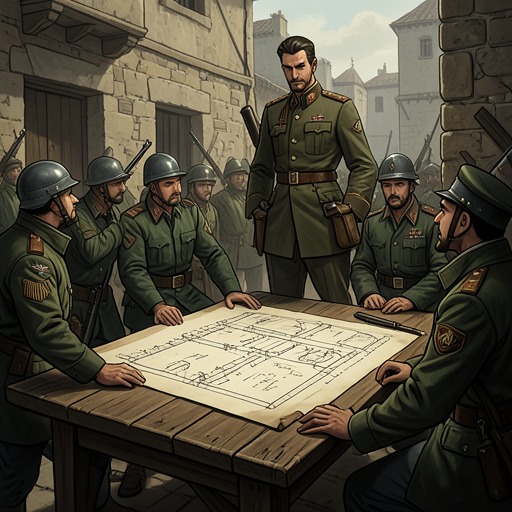
Moroni prepares himself as both commander and symbolic representative. He puts on his head-plate, breastplate, shields, and armor, then takes a pole bearing his rent coat. On the remaining portion of the garment he writes a message invoking the defense of liberty, religion, and the people’s rights. The ordinary material of torn clothing becomes a banner, and the damaged coat carries the memory of threatened communal integrity.
Moroni then calls upon everyone who will maintain this title upon the land to come forward in the strength of the Lord. The wording gives the covenant two inseparable dimensions. It is a political commitment to maintain rights and liberty, but it is also a religious commitment made under divine dependence. The people are not invited to trust military power alone; they are asked to enter the covenant so that the Lord God may bless their defense.
The Collective Act of Covenanting
The people respond immediately and physically. They come running together with armor girded about their loins, showing that the summons has become mobilization. Yet their response is not merely military. They rend their own garments as a token, reproducing the sign first displayed by Moroni and converting an individual emblem into a communal rite.
The torn clothing carries a conditional warning. The people covenant that, if they fall into transgression, the Lord should rend them even as they have rent their garments in the name of Christ. Their pledge therefore contains both promise and self-imposed judgment. The covenant does not simply demand loyalty from others; it places the covenanting people themselves under the standard they affirm. Their broken garments are offered at Moroni’s feet, and the act makes submission to the covenant visible before the community.
Moroni interprets the garment through ancestry. The people are a remnant of the seed of Jacob and of Joseph, whose coat recalls the divided and endangered history associated with their forebears. The image thus connects the present emergency with a longer identity: the community’s rights and religion are not detached possessions but part of an inherited history that the people are responsible to preserve. The covenant gathers military action, kinship memory, and devotion to Christ into one public symbol.
Enforcement, Repair, and Narrative Significance
The covenant’s structure differs sharply from secret combinations. Secret groups distinguish a brother through signs and secret words and use concealed affiliation to organize theft and power. The Title of Liberty covenant reverses that logic. Its sign is displayed before the people, its words are proclaimed aloud, its participants gather in one place, and its obligations are witnessed through a shared gesture. Where secret organization hides responsibility, the covenant exposes it.
The same contrast appears in the later discipline of the church. Those received through baptism are cleansed by the power of the Holy Ghost and are expected to remain determined to serve Christ to the end. Church members are also kept to strict standards: iniquity is not to remain among them, and those condemned by three witnesses of the church are brought before the elders. These practices show a broader pattern of communal order in which belonging requires continuing accountability rather than a single profession. The Title of Liberty covenant belongs to that pattern, but expresses it under wartime pressure and in the language of public defense.
Its moral logic also distinguishes defensive solidarity from revenge. The people are called to protect rights and religion, not to sanctify every use of violence. The record elsewhere presents the Anti-Nephi-Lehies as having undergone a change in their relation to violence, while their king urges them to receive brethren sent by God. That contrast clarifies the covenant’s place within the larger narrative: it is a response to an immediate political and military threat, whereas repentance and reconciliation can require the cessation of violence, mercy, and restored fellowship.
The covenant’s significance lies in the way it turns a divided population into an accountable body. Moroni’s torn coat supplies the image, his proclamation supplies the political and religious frame, and the people’s armor and torn garments supply collective action. The result is neither private conviction nor mere conscription. It is a public promise in which liberty is defended as a shared trust, religion is treated as part of communal identity, and the defenders accept that betrayal would place them under the same judgment represented by the torn sign.